

In Flint, They Knocked Anyway

Author: Munira Bangee
Date: June 15, 2026
Flint Cancer Screening Trust Begins at the Door
The temperature had dropped below zero. The canvassers came regardless. What happened next said something about trust and about what it takes to rebuild it.
FLINT, Mich. The cold arrived before the sun did.
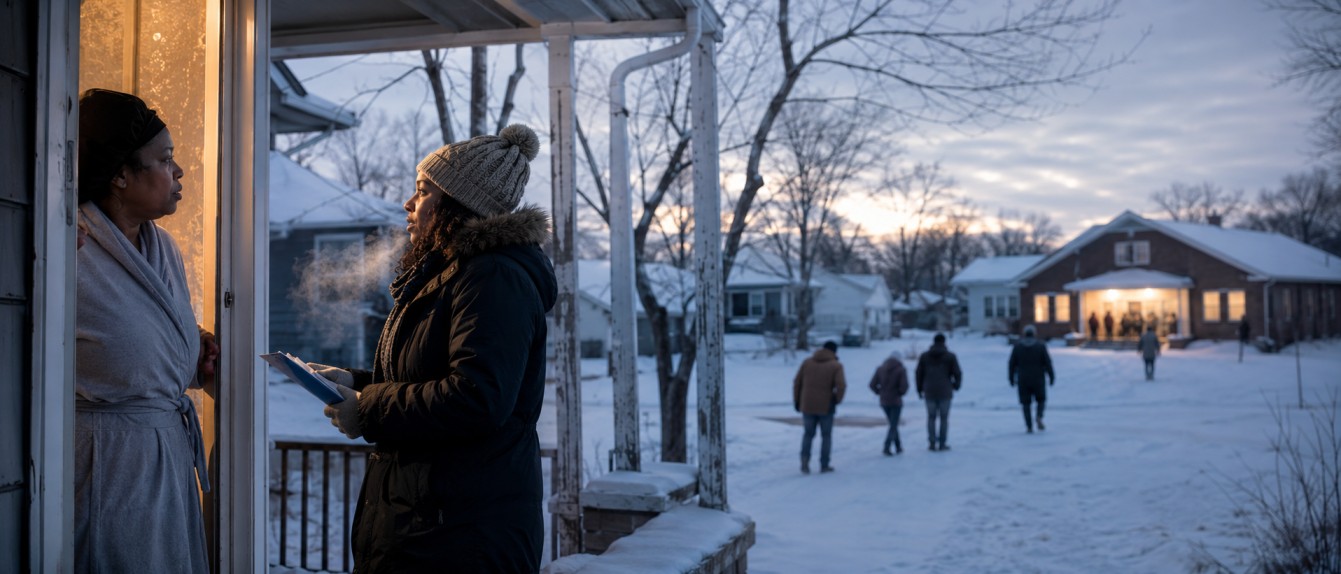
By the time the first canvassers pulled on their gloves and stepped into the gray January morning, the air had settled into the kind of stillness that stings. Breath hung in small clouds. Snow groaned underfoot. The neighborhoods, rows of modest homes with storm doors and sagging gutters, were quiet in the way places grow quiet when people have learned not to expect much from the knock at the door.
They knocked anyway.
At one house on the north side, a woman answered, just barely. She held the door close to her body. She had lived in Flint long enough to recognize the rhythm of this. Someone from outside arriving with a purpose, a program, a promise. She had seen what happened after those visits. The vans left. The clipboards disappeared. The phone numbers rang and rang.
But this felt different. The person on her porch was not rushing through a script. They asked how she was and listened to the answer. Then they told her about a Town Hall being held nearby, a gathering that included information about an early cancer detection screening study, other health screenings, and access to resources, all centered on having a real conversation about her wellbeing. Not as a statistic. Not as a zip code. As a person whose health belonged to her.
She said she would think about it.
She came.
NMQF came to Flint as part of the launch of its Cancer Screening and Support Initiative, a study focused on improving access to early cancer detection in communities that have long faced barriers to care. The work began with what any honest effort must begin with: presence. Before any screenings could happen, before any data could be gathered, someone had to show up and ask residents if they were willing to be part of something. That meant canvassing in the cold, informing the community about our town hall, and listening to the community’s concerns.
Flint has carried a particular weight in the American imagination since 2014, when lead contaminated its water supply and the country watched as a city asked for help and waited. What followed, the investigations, the lawsuits, the slow remediation, left behind something that water filters and settlements could not fully repair. A deep and rational wariness of institutions that claim to help.
That wariness does not make Flint unique. Across the country, communities with histories of neglect have learned that programs come and programs go. Studies are conducted. Reports are filed. And then the vans leave. What remains is the gap between what was promised and what arrived, a gap that over time becomes its own kind of injury.
This is the terrain that health equity work must navigate. Not just the absence of clinics or the shortage of specialists, though those are real. It is also the accumulated weight of disappointment that makes a person hesitate before opening the door.
The canvassers understood this, or tried to. They did not expect trust to form quickly. They came because someone decided that presence mattered, that showing up in below zero temperatures without certainty of a warm reception was the only honest place to begin.
“You can’t outsource this kind of work,” one canvasser said, stamping warmth back into her feet. “People know when you mean it. And the only way to mean it is to be here.”
By midday, the neighborhood had taken notice, not with fanfare, but with the quiet accumulation of small decisions. A woman who had watched from her window opened the door. A man who had been skeptical changed his mind after a neighbor told him she was going. An elderly couple came together, moving slowly, holding each other’s arms against the ice.
When the doors of the Town Hall and Mini Clinic opened, the room filled in a way that felt earned.
Inside, the questions were not gentle. People asked about the limits of the screenings, about what would happen to their information, about whether the help being offered would still be there next year. Some asked with an edge in their voice rooted not in rudeness, but in experience.
Our organization, National Minority Quality Forum (NMQF) answered all their questions. Sometimes it was an acknowledgment that the concern was fair, followed by a concrete step forward. What mattered was not perfection, but responsiveness. NMQF did not shy away from the hard questions. We stayed in the conversation, offered transparency, and made it clear that building trust was not a talking point, but an ongoing commitment backed by action.
What lingered in the room, beyond the blood pressure checks and paperwork and folding chairs, was harder to measure than attendance numbers. It was the quality of attention. The sense that NMQF had decided before arriving in Flint that residents deserved more than efficiency. They deserved to be heard.
What happens next is just as important as that first knock, and there is every reason to believe the work will continue. Trust is not a single moment; it is built through steady presence and consistent follow-through. In Flint, the commitment did not end when the doors closed. It moves forward in the relationships formed, the screenings initiated, and the promise to return.
Munira Bangee is the Vice President for the Center for Sustainable Health Care, Quality and Equity.
Also Read: Building Health Advocacy with Trusted Voices
Related articles




Sign Up for Email Updates
Join the 700,000+ people getting our email updates!